

 Château de Versailles spectacles


 Francais
 English
 support
Queen's theater
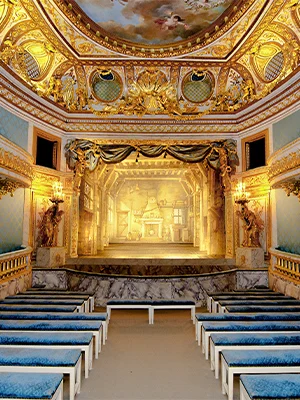
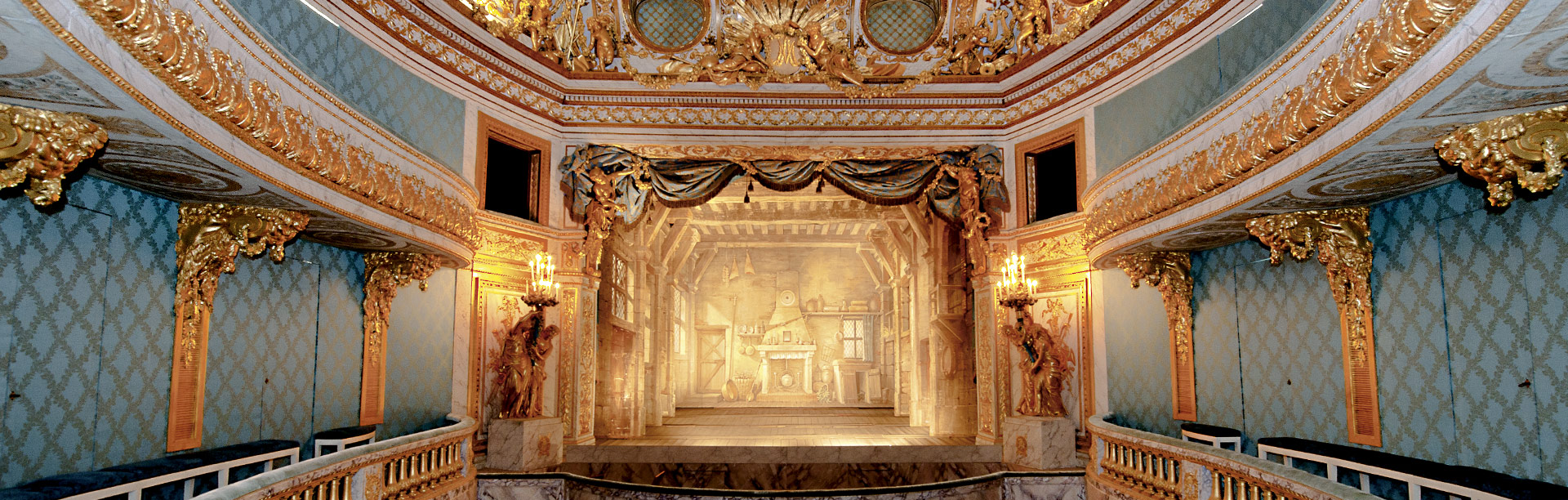
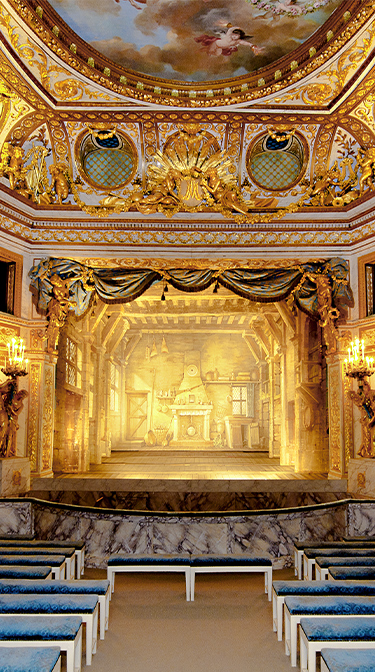
To indulge her deep appreciation of the arts, and theatre in particular, Marie Antoinette commissioned the architect Richard Mique to build a theatre within her new estate at Trianon. Cleverly concealed within the gardens of the Petit Trianon, the Queen’s Theatre was completed in the spring of 1780 and inaugurated on 1 June of the same year. This intimate jewel box of a theatre, decorated in blue with gilded embellishments, accommodated just 120 spectators, ensuring an atmosphere of exclusivity and privacy. Performances were attended only by members of the royal family and the Queen’s close circle of friends.
Show moreAfter 1785, the Queen largely abandoned the theatre, which spared it from significant damage during the French Revolution. Its original stage machinery has since been restored and remains fully operational today, making the Trianon Theatre the only surviving eighteenth-century French theatre still intact and capable of functioning as originally intended. Historic stage sets have also survived and continue to be used: a set created in 1754 for the first act of Lully’s Thésée, together with nineteenth-century scenery by Pierre-Luc-Charles Cicéri, including a rustic interior, a forest, and fragments of a public square and an elegant salon.
As a patron of the performing arts, the Queen commissioned works that reflected her taste for the music of her time, staging operas by Grétry, Sacchini, Paisiello and Gluck. Having studied under Gluck herself, she formed her own amateur company, the “Troupe des Seigneurs”, and regularly appeared on stage in costume. Among her notable roles was the heroine of Rousseau’s Le Devin du Village. This work by the philosopher was revived at the Queen’s Theatre in 2017 and is available on CD and DVD as part of the Château de Versailles Spectacles recording collection.
For two exceptional performances, the Orchestra of the Royal Opera House takes to the pit of this jewel of Marie Antoinette’s creation, presenting Gluck’s Le Cinesi and Hasse’s Marc’Antonio e Cleopatra.