

 Château de Versailles spectacles


 Francais
 English
 support

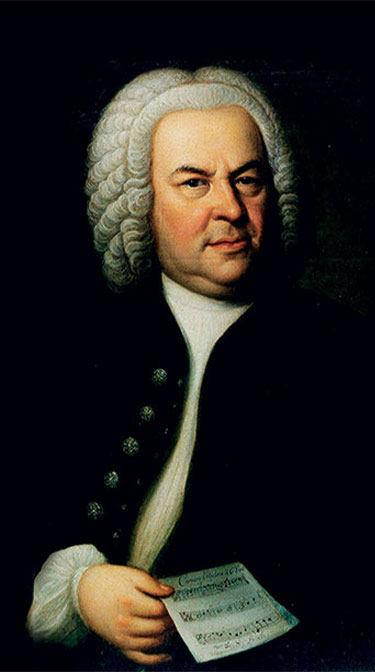
Johann Sebastian Bach
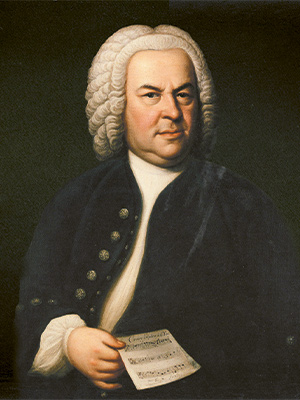
Johann Sebastian Bach, an iconic figure in Baroque and classical music, continues to captivate audiences through his exceptional mastery of musical structure and the emotional richness of his works. His style, combining virtuosity with refined harmony, remains an inexhaustible source of inspiration for musicians of every era.
JOHANN SEBASTIAN BACH (1685-1750)
Johann Sebastian Bach is undoubtedly the most emblematic composer of German music at the turn of the 18th century. Born in 1685 — the same year as George Frideric Handel and Domenico Scarlatti — in Thuringia, in central Germany, he was above all a brilliant organist and a Lutheran Kapellmeister in the fullest sense of the term. Deeply curious about the music of his time, he absorbed French influences — notably those of François Couperin — as well as Italian styles. He transcribed numerous works by Antonio Vivaldi and even parodied Giovanni Battista Pergolesi, blending these influences with the powerful heritage of North German music. The result was a vast sacred oeuvre distinguished by constant inventiveness, structural strength and a genius that placed his work above much of what was being composed in Central Europe at the time. He explored every musical genre of his era except opera. A supreme keyboard virtuoso, he left behind an unrivalled body of works for organ and harpsichord.
Show moreBorn in Eisenach in 1685 into a long line of central German musicians, Bach was shaped by an exceptional musical tradition and a profound Lutheran faith. Eisenach lies at the foot of the Wartburg Castle, the medieval fortress where Martin Luther took refuge to translate the Bible into German — without Luther, there would have been no Bach. Raised by his uncle Johann Christoph, organist in Ohrdruf, he studied music from an early age, particularly singing, keyboard and violin, travelled to Hamburg to hear the great northern masters, and trained in organ building. His career began as organist in Arnstadt in 1703, where he composed his first cantatas and organ works.
In 1705, Bach undertook a four-hundred-kilometre journey on foot to Lübeck to meet Dietrich Buxtehude, the great master of the German organ tradition. Buxtehude profoundly influenced the young composer, steering his music towards greater depth and radicalism. Returning to Arnstadt, frustrated by the poor quality of the musicians at his disposal, Bach accepted the post of organist in Mühlhausen, where he consolidated his growing reputation. In 1708, he secured a prestigious position at the Lutheran court of Weimar, whose accomplished musicians finally allowed him to work at the highest level. Many of Bach’s earliest masterpieces date from the decade he spent there: extraordinary cycles of cantatas — he was expected to provide a new one every month — as well as most of his major organ works, including the famous Toccata and Fugue in D minor and the monumental Passacaglia and Fugue in C minor.
Between 1717 and 1723, Bach accepted a new post at the court of Köthen, where he encountered a very different environment. Calvinist practice forbade sacred music, yet Prince Leopold of Anhalt-Köthen maintained an excellent orchestra and was passionately devoted to music. This period produced an abundance of masterpieces: the Orchestral Suites, the Sonatas and Partitas for Solo Violin, the Cello Suites, numerous chamber works, and the celebrated Brandenburg Concertos dedicated in 1721 to Margrave Christian Ludwig of Brandenburg-Schwedt. He also composed the violin concertos, harpsichord concertos, the English Suites, French Suites, the first book of The Well-Tempered Clavier, and the Inventions and Sinfonias. However, the prince’s marriage to a wife indifferent to music diminished Bach’s prospects, prompting him to seek opportunities elsewhere.
In Leipzig, where he served as cantor from 1723 until his death in 1750, Bach held the city’s foremost musical position at St. Thomas Church. The role also involved teaching music and Latin to around sixty pupils, though only a third possessed the standard required for his works. Bach directed music for the Lutheran churches of St Thomas and St Nicholas, as well as for official civic and university ceremonies. During the first years of this intense activity, he composed primarily sacred cantatas to build the repertory required for worship, alongside the Easter Oratorio, the Magnificat in D major, and the Passions according to St John, St Matthew, St Luke and St Mark, all premiered for Good Friday services. In these works, Bach elevated the German Passion tradition to an extraordinary level of achievement, expanding the dramatic role of the chorus and punctuating the Gospel narrative with deeply expressive arias. Alongside more than three hundred sacred cantatas, he also composed several major secular cantatas for the magnificent Saxon court in Dresden. The accession of Frederick Augustus II in 1733 inspired the Latin Mass that would later become the monumental Mass in B minor.
The final years of Bach’s career were devoted increasingly to more theoretical compositions — monumental summations of his musical knowledge. The unfinished The Art of Fugue stands as the ultimate symbol of this period, alongside the Musical Offering, the later books of The Well-Tempered Clavier, and the celebrated Goldberg Variations. Though he received little international recognition during his lifetime, Bach found joy in his large family: twenty children were born from his two marriages, although only ten survived into adulthood. His legacy was initially carried forward by his sons — notably Johann Christian Bach, Wilhelm Friedemann Bach and Carl Philipp Emanuel Bach — themselves distinguished musicians. The rediscovery of his music began with Felix Mendelssohn’s revival of the St Matthew Passion in Berlin in 1829, followed by the publication of his complete works by the Bach Gesellschaft in 1851. From then on, Bach came to be regarded as the “father of German music”, a status reinforced throughout the nineteenth and twentieth centuries.
An extraordinary virtuoso of both keyboard and organ — he composed around 250 organ works, including 150 chorale settings — Bach brought to perfection the two great principles of German Baroque music: polyphony and counterpoint. Upon these foundations he built the architecture of his great choral and orchestral works, skilfully combining Italian expressive affects with French dance models. The synthesis he achieved, perhaps comparable to that of George Frideric Handel in England, remains uniquely original. It undoubtedly owes much to the profound sense of text and spiritual expression that underpins the writing of “Bach the Immortal”, earning him the enduring title of “the fifth evangelist”.