

 Château de Versailles spectacles


 Francais
 English
 support

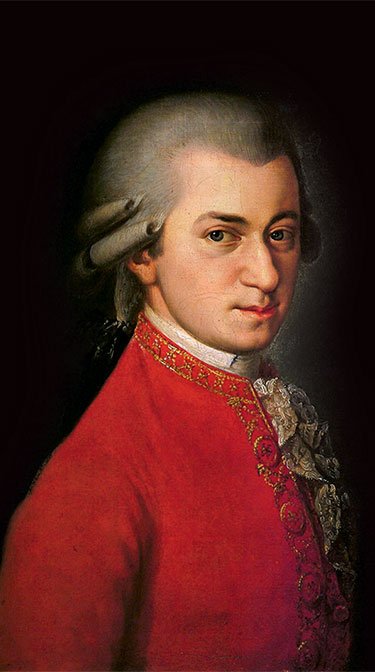
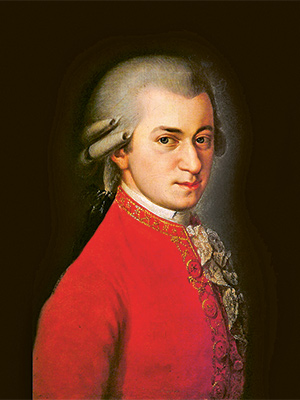
Wolfgang Amadeus Mozart
From drama to comedy, from sacred devotion to the brilliance of bel canto, Mozart brings the full breadth of his musical genius to the Royal Opera. Through timeless masterpieces, unfinished works and outstanding recitals, this selection celebrates the dramatic power, virtuosity and emotional depth that make him one of the most captivating composers in history.
WOLFGANG AMADEUS MOZART (1756-1791)
Few lives in the history of music have acquired, over time, such powerful and universal resonance as that of Mozart.
Wolfgang Amadeus Mozart was born in Salzburg in 1756. His father, Leopold, a violinist in the Archbishop’s Court Orchestra who became Court and Chamber Composer in 1757, quickly recognised his son’s extraordinary gifts. When he began giving Wolfgang his first formal keyboard lessons, the boy was only four years old, yet already displayed remarkable aptitude. Leopold immediately set about cultivating these talents and, in 1762, six-year-old Wolfgang and his sister Nannerl, five years his senior, performed before Empress Maria Theresa at Schönbrunn Palace.
Show moreFrom 1763 onwards, the family embarked on a three-year tour across Germany and as far as Paris, where the Mozarts spent five months and were celebrated wherever they appeared, including at Versailles. From Madame de Pompadour to the circle of German musicians in the French capital, the young Mozart encountered a host of fascinating figures—among them Philidor—and began composing brilliantly for the harpsichord. The journey then took the family to London, where they remained for sixteen months. There, Mozart was received by the royal family and met Johann Christian Bach, an encounter that would prove decisive. He composed his first symphonies and performed in the celebrated Bach–Abel concerts. The tour continued to the Netherlands, where he suffered a serious illness brought on by exhaustion, before returning via Paris and travelling through France and Switzerland back to Salzburg in 1766.
The years that followed saw the composition of his first sacred works and, in Vienna in 1768, his first opera, La finta semplice, soon followed by Bastien und Bastienne. In 1769 he embarked on his first journey to Italy: fifteen months of concerts, encounters and discoveries, including audiences with the Pope and meetings with Padre Martini and Mysliveček. During this period he received a commission for Mitridate, Re di Ponto, premiered in Milan in 1770 by a composer who was only fourteen years old.
In 1772, Salzburg’s new Archbishop, Hieronymus Colloredo, appointed Mozart Konzertmeister. The position encouraged him to compose numerous symphonies, but opera remained his greatest passion. Prestigious commissions led him once more across Europe: Lucio Silla premiered in Milan in 1772, followed by La finta giardiniera in Munich in 1775, while Il re pastore was created in Salzburg. This period also produced a succession of masterpieces, including the first piano concertos—among them the revolutionary Piano Concerto No. 9, known as the “Jeunehomme” Concerto (1777)—as well as sonatas, string quartets and major sacred works.
Relations with Archbishop Colloredo deteriorated when Mozart was refused leave for a further journey. He resigned and set off for Mannheim and then Paris, arriving there in 1778 in the hope of securing a permanent position. The only post offered to him was that of organist at the Royal Chapel of Versailles, which he declined. Despite receiving commissions for several symphonies and the Concerto for Flute and Harp, he left disappointed. The trip was made all the more tragic by the death of his mother, who passed away in Paris at his side. Returning reluctantly to Salzburg, he was appointed Court Organist in January 1779.
The conflict with Colloredo nevertheless continued to intensify, and in 1781 Mozart settled in Vienna as an independent musician, shortly after the premiere of Idomeneo in Munich. There he married Constanze Weber in 1782, the same year that Die Entführung aus dem Serail, commissioned by Emperor Joseph II, was premiered at the Burgtheater. This German-language singspiel—essentially an opéra-comique in the French tradition adapted to the local language—caused a sensation.
A period of remarkable success followed. Mozart composed symphonies such as the “Haffner” and “Linz”, as well as quartets, sonatas and piano concertos. He forged important friendships, most notably with Joseph Haydn, twenty-four years his senior, with whom he shared deep mutual admiration. Baron van Swieten introduced him to the music of Bach and Handel, while his admission into Freemasonry further enriched his intellectual and artistic horizons.
Yet Mozart was obliged to earn his living through his music at a time when most composers sought the security of a permanent court appointment. Income from private teaching and public concerts sustained him, but never reliably. Nevertheless, he produced an astonishing quantity of music, often performing it himself. Alongside the twelve mature piano concertos, he composed operas of extraordinary genius, notably the Da Ponte trilogy: The Marriage of Figaro (Vienna, 1786), Don Giovanni (Prague, 1787), and Così fan tutte (Vienna, 1790).
In 1787 Joseph II appointed him Imperial and Royal Chamber Composer, yet the salary attached to the post proved disappointing and did little to relieve his growing debts. Vienna’s elite never fully recognised the extent of his exceptional talent and left him struggling with mounting financial difficulties. In 1788 Antonio Salieri, newly celebrated for his triumphs in Paris, was appointed Imperial Kapellmeister, becoming the focus of Viennese attention for the following decade and occupying the place once held by Gluck in the city’s musical pantheon.
Despite continuing successes, 1791 would be Mozart’s final year. Even as his health declined, his creative powers remained astonishing. He composed the sublime Clarinet Concerto, his final Piano Concerto, La clemenza di Tito for the Prague Opera, and finally The Magic Flute, the incomparable singspiel written for and conducted by Schikaneder at the Theater auf der Wieden. Yet its triumph was almost posthumous: Mozart died only two months after the opera’s premiere. He left behind numerous unfinished works, most famously the Requiem, as well as a grieving widow and two children in difficult circumstances.
This life, marked by brilliance and hardship, acclaim and disappointment, and cut short in the full maturity of genius, was already regarded as tragic during the Romantic era. Mozart came to be seen alongside figures such as Schubert and Büchner as one of the great German-speaking artists whose gifts were insufficiently recognised in their own lifetime. Legends soon embellished the story, from the myth of the pauper’s grave to the enduring influence of Pushkin’s controversial Mozart and Salieri.
Perhaps the greatest source of regret is the music Mozart might have composed had he lived another forty years, as Haydn did. What if he had died in the same year as Beethoven, in 1827? Or even in 1830, when Berlioz unveiled his Symphonie fantastique? Such possibilities open dizzying perspectives on musical history.
Today, Mozart’s legacy stands at the very summit of the repertoire. His operas and keyboard works remain constant fixtures on concert stages, while the Requiem has become emblematic of a new emotional intensity that foreshadowed Romanticism. Without overturning musical conventions as Beethoven would later do, Mozart brought the forms of his age to an unparalleled level of perfection. His extraordinary ability to fuse Italian, German and French styles, and to draw the fullest expressive potential from librettos, instruments and voices, remains unmatched.
The timeless classicism of his music, its incomparable understanding of human emotion and especially of female characters, continues to captivate audiences long after the aristocratic world that nurtured it disappeared. The apparent simplicity of his writing, and its disarming ability to move listeners so profoundly, ensure that, even today, “the silence that follows” still belongs to Mozart.